

“I’m not sure about going ahead.” What would you ask next?
The person might be worried about the treatment, unsure why it was suggested or unable to arrange transport. You won’t know which from that sentence alone.
That is one of the challenges behind a useful simulated consultation. The patient needs to give you something to explore without simply delivering all the answers at once.
Information comes out through conversation
The new simulation engine supports scenario information and participant behaviour that become relevant as the conversation develops. For example:
- A concern may need an invitation before it is shared.
- A misunderstanding may become apparent when someone explains their view.
- A brief answer may call for a follow-up question, rather than a change of topic.
The purpose is to make listening and follow-up worthwhile. It is not to hide a fact behind one exact phrase that the learner has to guess.
Different questions, different openings
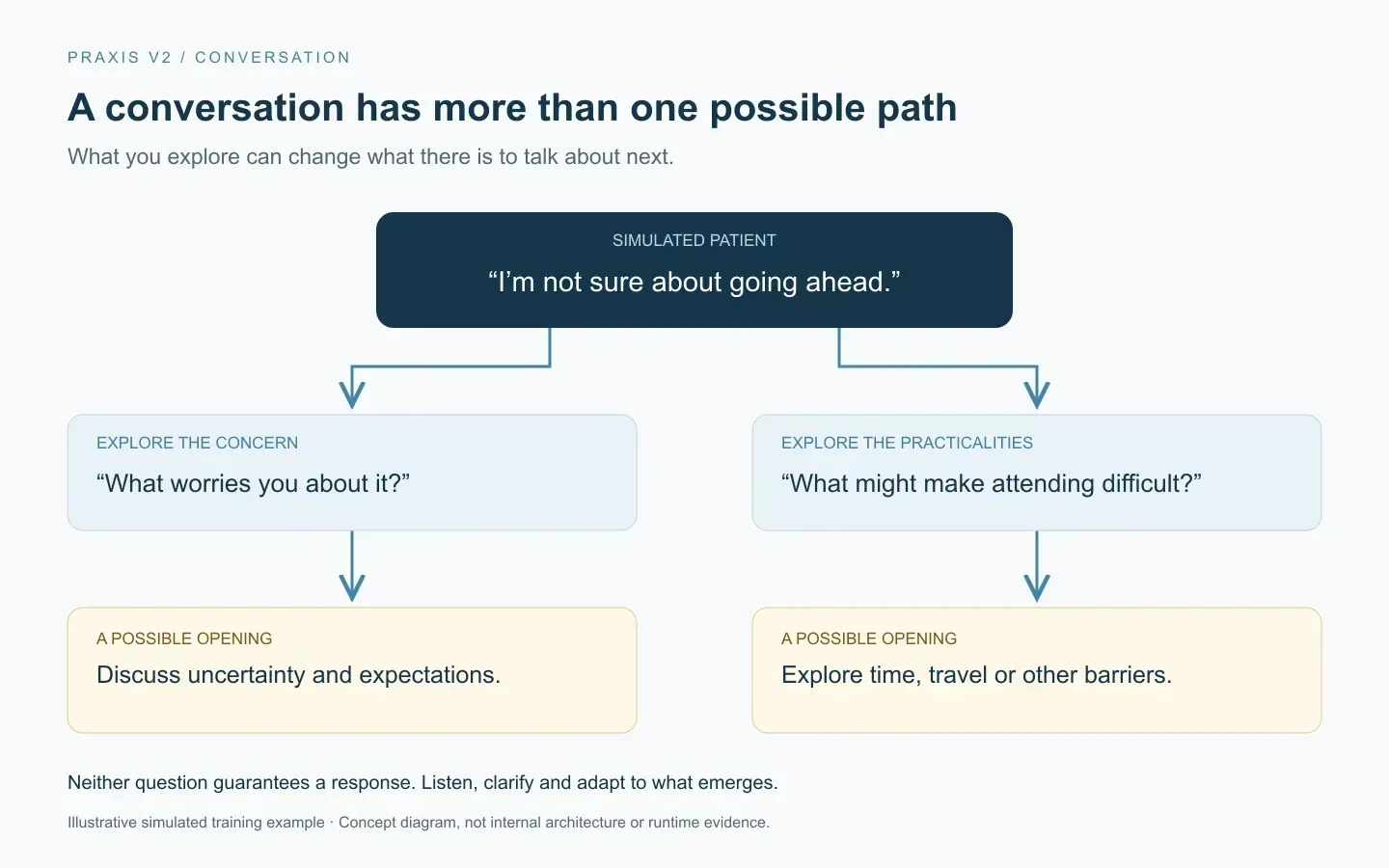
In this fictional example, asking “What worries you about it?” opens a different discussion from “What might make attending difficult?” Someone could have both concerns, or neither. The questions create possibilities; they do not force particular responses.
The learning happens in what you do with the answer: follow it up, check your interpretation or recognise that you have been pursuing the wrong concern.
More than one person in the room
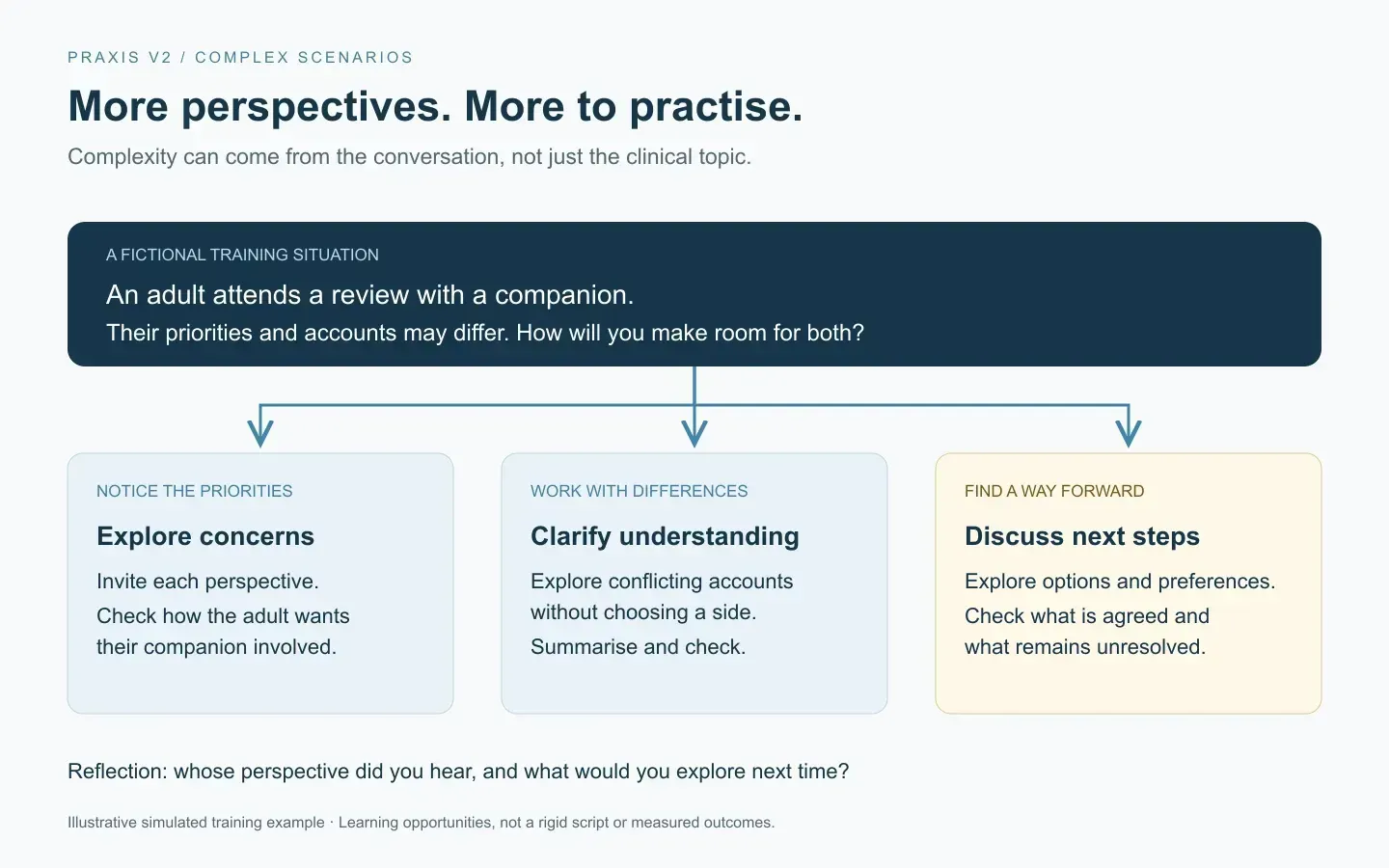
The engine also supports multiple simulated participants. A patient and companion can bring different accounts or priorities, giving you a reason to think about whose perspective you have heard.
Those scenarios create opportunities to practise:
- Checking how the patient wants a companion involved.
- Making room for another account without losing the patient’s voice.
- Responding when participation or priorities change.
Adding another voice is useful only when it serves the learning task. A focused conversation with one patient may be the better choice for a particular skill.
The illustration and diagram describe fictional training situations, not real patient care or guaranteed model responses. AI-generated dialogue can still be imperfect; this work does not establish measured educational outcomes.
For the learner, the point of the new engine is a conversation worth paying attention to: one where what you ask, what you notice and what you explore next all have a purpose.